
By David K. Wilder (See bio at end of article*)
The American Constitutional Worldview
 Our Republic started with a unique, and often actively ignored, remarkable premise for structuring government. Individual rights do not come from government. They come from our Creator, from the Laws of Nature and Nature’s God, and therefore exist beyond the reach of political fashion, bureaucratic ambition, or temporary majorities.
This fundamental truth established the central purpose of American government — to protect liberty, not to expand its own power. The Constitution was written to enshrine this principle through a limited federal government, with most authority reserved for the states and the people. Government was not created to grant liberty. It was created to protect liberty.
The Articles of Confederation were our first attempt but needed some critical updates for our Republic to function. The Constitutional Convention had the task of building on the Articles to create a functional federal structure. Our present Constitution, with the amendments, is the ongoing effort to put the American World View into practice.
The Federal Structure Was Designed to Restrain Power
The Founders did not fear freedom nearly as much as they feared concentrated power.
From the Federalist Papers to the debates of the Constitutional Convention, the historical record is unmistakable: the federal government was intended to be limited, defined, and restrained. You cannot enshrine individual liberties if the government has power to nullify them.
Article I is the clearest expression of this principle. Congress was granted only specific, enumerated powers (Constitution Article I, Section 8). Anything not expressly delegated to the federal government was reserved to the states and to the people.
This was not accidental language. It was the structural safeguard of liberty.
The Supremacy Clause does not give Washington unlimited authority. Federal law is supreme only when enacted within the constitutional powers delegated to Congress. Outside those boundaries, authority belongs to the states or the people.
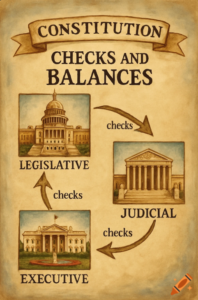 That balance has been systematically eroded.
That vision has been turned upside down. Today, the federal government has become a bloated, overreaching behemoth that routinely ignores its enumerated powers, tramples state sovereignty, and does not have the consent of the governed. Congress passes laws on issues it has no constitutional authority to touch. The executive and judicial branches cheer it on. The servant has become the master, and Americans are paying the price through crushing debt, declining liberty, and diminishing self-government. The result is a federal government increasingly detached from constitutional restraint and increasingly hostile to the principle of self-government.
Enough is enough.
Authority Hierarchy
Without firm and principled integrity any organization will eventually succumb to the weaknesses of its members. Every generation is warned that power corrupts. Every generation ignores the warning until the consequences become impossible to deny.
The Founders anticipated this danger. They understood that governments naturally seek to accumulate more authority over time. They also understood the most common justification for this expansion: the promise of a “better idea.”
Our country has gone down this path for such a long time most don’t even notice the subtle tyranny that exists. It is a rational and easily defended conclusion to note that Congress has acted well beyond its given authority. Liberty is sacrificed in pursuit of political agendas, administrative convenience, or utopian promises. All too often the Judicial and Executive branches have been willing partners.
In today’s America there are words you cannot utter, lifestyles you cannot question, beliefs you cannot express, protections that are made illegal. To express any moral judgement is in itself judged as hateful.
Recognizing this reality is neither radical nor extreme. It is an honest assessment of how far modern government has drifted away from the constitutional structure designed to preserve liberty.
The Framers anticipated exactly this danger, which is why they included amending processes in Article V.
The Democracy Test
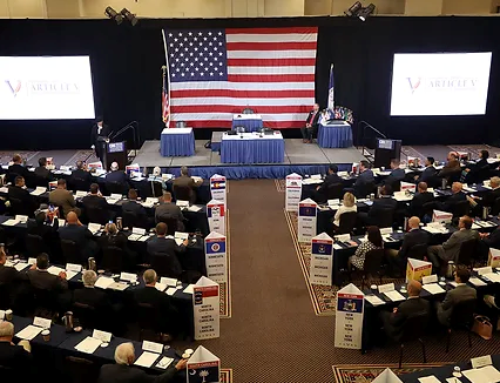
Central to the Article V Taskforce’s mission is promoting the authority of everyday Americans through their constitutional right to hold amendment-proposing conventions. This is the ultimate, and last peaceful line of defense against an overbearing central government.
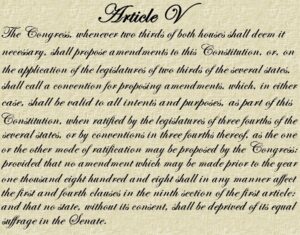 Article V was not included as a historical curiosity. It was designed as an emergency constitutional mechanism — a peaceful remedy when the federal government became too powerful or too unwilling to reform itself
The People are for it. Term Limits, Election Finance Reform, Controlling Federal Spending and other topics have had overwhelming popular support for decades. These ideas consistently receive broad bipartisan support among ordinary Americans
The States are for it. This is stated through policy, like the Massachusetts Citizens Commission report of 2019, and by the hundreds of applications made by State legislators in response to its citizens.
Congress is against it. Congress actively blocks the process to protect its own power and perks. Their inaction is unconstitutional and self-serving. Members of Congress routinely campaign on promises of reform while benefiting from the very system they claim to oppose. Career politicians, entrenched bureaucracies, and political activist organizations all profit from permanent dysfunction.
Activist groups and professional agitators are against it. Fixing real problems would dry up their fundraising streams. They need crisis and grievance to stay relevant — actual solutions are bad for business
Big-Government Advocates are against it. They fear a convention because they want Washington to keep imposing their agenda on the entire country.
A truly effective constitutional correction would reduce the influence of big-government lobbyist and return swing power back to the states.
Deceptions and False Information
Rejecting the authority of the Constitution, historic precedence and failing to understand federalism allows many detractors to pose imagined pitfalls should a convention occur.
The most often used is the fear of a ‘run away’ convention. The idea is that there is no way to control the convention, so crazy ideas may result – including rewriting the entire constitution. Ironically these detractors seem fine with the run-away Federal government, that is the reality before us.
This run-away argument is easily debunked, but many legislators are cowed by the ‘what-if’ fears. Much has been written to correct this false fear, but here is the general gauntlet a bad actor must overcome to create a ‘run-away’.
 The applications and the State convening announcement define the topic to be discussed. In over 600 inter-state/colony conventions in our history all have stayed on topic with zero off-topic results. With 400 plus years of governing using conventions or congresses, the rules and procedures are well understood and established for orderly progress.
- Each state has one vote, and the State delegates have a commission. That commission, granted by the legislature, outlines the duties and responsibilities of the delegate. What can and cannot be done can be explicitly stated with removal and penalties for breaking it.
- So, if a bad actor can cancel or override the convention procedures, including the voted upon rules, and ignore his own commission to propose an off-topic amendment, what happens? A majority of States would have to agree…which simply proposes this off-topic amendment.
- That is the easy part of the process. The real difficulty is convincing ¾ of the states (38) to ratify said amendment.
It is impossible to realistically envision any scenario where a run-away idea makes it through this process.
How We Win
Thanks to our partners at NFC.gov and FFSF.us, the threshold has already proven to have been met on fiscal responsibility. States now have the clear authority to convene. The process is ready. The only thing missing is the political will to move forward despite congressional resistance.
They didn’t do it. For years. Democrats and Republicans have stifled this constitutional state right.
Many commentators voice that the ‘Congress shall call’ language is a required authorization to move forward. AVT contends this point of view is incorrect. Why?
- Congress has no power to halt any states from holding conventions. That is not an enumerated power, so the authority rests, always, with the states according to the constitution.
- SCOTUS, via Dillon v Gloss (1921) recognize the State’s power to have this constitutional authority. As soon as the required number of States act, Congress need not recognize or announce the results since the States have the power to implement the result.
- Historical records document that the sole purpose of adding the state convention pathway is to over-ride an out-of-control Congress. Assuming they can stop this by ignoring it or not making the ‘call’ is clearly counter to that purpose and would make no sense.
Recognizing these facts means the States submitting the required number of applications creates the authority to convene. The concurrent action of Congress to ‘call’ the convention is simply an administrative announcement and is not an approval or authorization the States require.
At this moment, the States can call a convention to propose amendments to fix Washington’s spending habits. This was authorized as early as 1979, and again in 2016. A State would simply invite the states to gather at a given time and place, and it happens.
Why the Article V Taskforce?
Our citizens and representatives in large part are not familiar with the Article V process. Job number 1 is providing education. Building that knowledge base and seeking partners and volunteers to help us spread the word is part of that.
 We have an awesome opportunity to actually have an Article V amending convention now. Advocating and pursuing this goal would be the achievement of a lifetime. Our future is in jeopardy if we do not get spending and debt under control. The Federal Treasury has stated the country is insolvent – so that should give you an idea of how bad things have gotten – and we’ve little time to correct it.
We believe in our country and the Constitution. We support any AV movement that will help restore the proper structure and authority in our governments.
——–
*David K Wilder (Dave) is a retired engineer and business management consultant who has dedicated his post-career efforts to advancing constitutional governance and civic engagement. Applying a results-oriented approach developed over decades in engineering and consulting, he founded the Fifteen Minute Patriot and co-founded the Article V Taskforce to educate citizens and public officials on the constitutional amendment process and the principles underlying the American Republic.
Drawing on the Constitution and the nation’s founding documents, Dave advocates for informed citizen participation in government and supports the responsible use of an Article V convention to strengthen the protection of individual liberty and constitutional self-governance.
Dave resides in Massachusetts with his wife of 48 years. He can be contacted at DWilder@AVTaskforce.org



Leave A Comment