
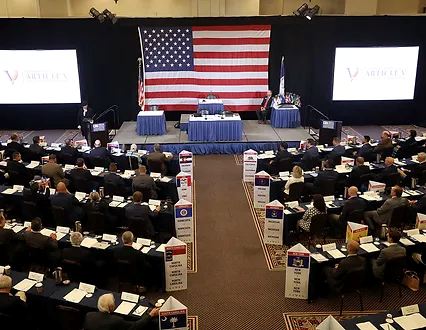
The States Story: What is a Convention of States (COS)?
By Mike Kapic – April 17, 2026
What IS a Convention?
America’s founders gave us a set of Freedom Charters that prescribe self-governance. Open this tool box and find the instrument given we the people for this chore: the second clause of Article V. It was not only intended to be used in case of emergency, but also everyday in every part of our busy lives.
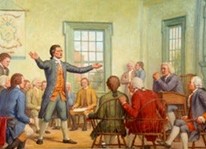 This essay only highlights some of the aspects of the recorded history of conventions. It is the readers responsibility to research the many recorded historical facts easily available from scholars and historians.
From the early 1600s to 2017 hundreds of records have been found of conventions resolving issues such as writing constitutions, safety, navigation, water rights, War, constitutional amending, ratifications, et al; even some non-Article V amending types.
All conventions by the colonies and then the states have operated successfully using the same standard operation procedure developed over the early centuries. The content here comes from the over 650 recorded gatherings over four centuries.
Basic Structure:
- As the frequency of conventions became more common, the development of standard operating procedures simplified their process to the point that everyone recognized how meetings were conducted.
- The SOP or standard operating procedure they developed consisted of two basic elements within the convention structure.
- The first was the simple meeting structure that proved successful over the centuries. First in the colonies and then codified into Article V.
- The second was the topic or subject for discussion. Their outcomes varied.
What a convention is:
- A tool of the people and their states at the first level of our democratic republic.
- Conventions are equal to other constitutional law.
- In early 1600s, churches and communities began meeting in convention to solve problems; they matured by the mid-1700s with a proven and intuitive standard operating process or SOP.
- It is the tool used by the States to invent the United States of America’s national government.
- Article V is just one of the tools within the States authority used through federalism.
- Established in the early colonial days it was codified into the U.S. Constitution.
- Conventions have lasted from 2 days to 4 months to 3 years; the average is 12 days.
- They generally operate at a lower energy level and have limited lobbying efforts than do regular legislatures or congresses.
- Nothing changes in convention because it is only allowed to propose. The same rule holds for Congress in its over 12,000 attempts to propose amendments.
- Formula for Article V conventions is: 34-26-38; 34 state apps, 26/50 states to agree, 38 states to approve.
- Amending conventions are non-plenary (limited) and authorized by their legislatures.
- States legally commission their delegates and define their instructions.
- State’s power allows them to commission, recall, suspend commissions, or discipline delegates.
- States can hold commissioners legally liable through delegate limitation acts.
- The people or their States shall approve or ratify anything the states or Congress proposes to the U.S. Constitution.
- They have historically honored the original call or subject as the purpose of the meeting.
- There is no legal requirement for exact language; intent is the rule, not verbiage.
- The States SOP operate in exactly the same manner as Congress proposes amendments.
- The States have applied over 700 times to Congress to accept their applications.
- Congress has maliciously and unconstitutionally forbidden the States from proposing their constitutional rights to meet repeatedly.
- Historically ignorant political groups claim using some parts of the Constitution could actually destroy America. That the Founders buried an IED explosive in the Constitution.
- The Colonies/States records show that in over 655 conventions, none misbehaved or ran away.
- America has held four non-Article V conventions that produced amendments that were never ratified (1814 Hartford, 1850 Nashville, 1861 Washington DC, & 1889 St. Lewis)
- An Article V convention is empowered to propose changes to the Constitution; it cannot, however, alter the method of ratification.
- It can propose to repeal an amendment (Congressional repeal of Prohibition proposal was ratified in 1933 by the people in state in conventions)
- In total, there have been 52 people’s conventions of states held to approve as required in Article V and Article VII. Not one ran away.
- A convention can propose ‘round abouts’ at every city street intersection.
- One state, one vote.
- The Supreme Court has favorably ruled in over three dozen cases regarding Article V.
- Dillon v. Gloss (1921) ensures that the last State to vote at the Article V threshold has consummated a Constitutional act. Anything beyond that moment is immaterial.
- Congressional proposals are motivated and instituted in the same manner as States.
- When Congress won’t act to redress a societal issue, the people turn to the States.
- Congress has ignored numerous times their responsibility to announce when the States had reached their 2/3rd threshold for applications in Article V.
What an amending convention is NOT:
A convention of states is not a fearful monster as portrayed by those few who utter their own ignorance of our true American history. Yelling FIRE in a packed theater is not only illegal but it creates dangerous chaos. Intentionally misrepresenting the words in our Constitution and its history as valid creates dangerous chaos to the lives of every American. Where is their evidence of wrong doing in our American history?
-
- The States created the Constitution as an extension of the Declaration’s ‘Laws of Nature and of Nature’s God’ for the peoples benefit, not our demise. They intended us to use the Constitution. Ignorant opposition implies there is a trip-wire explosive inside Article V.
- No misbehavior or run away found in any of the over 650 recorded conventions.
- Conventions history is replete with operations continuity and uniformity.
- Convention commissioners are not there to legislate but to debate and propose for a single resolution.
- A convention cannot remove anything. (the only way to remove e.g., 2nd Amendment would be for Congress or the States to propose an amendment to repeal)
- Delegates acknowledge that any abuse of the process will affect their reputations, their State leaders, fellow legislators and their own civil and criminal liabilities are at risk.
- The States are authorized equal powers throughout the Constitution.
- In defined areas, states are equal in status to Congress, the Executive and the Supreme Court.
- The Constitution is not an open book to rewrite as one pleases. Amending is an arduous process.
- It is not to be confused with a constitutional convention with an entirely different purpose. A hand-truck and semi-truck both use the word truck, but they aren’t confused for the same purpose.
- A proposed amendment is not completed without full approval of the people and their states.
- It does not have plenary power; it is limited and therefore not endowed with full sovereignty; as the state that sent them is.
- It has no authority to propose changes to the conventions subject.
- Does not have the authority to change or ratify anything without permission from the states.
- The convention’s sole purpose is to recommend.
- It cannot rewrite the Constitution.
- It cannot remove any amendments from the Constitution.
- It cannot reinstate slavery.
- It cannot take away women’s suffrage.
- It cannot force ‘round abouts’ at every intersection.
- A convention has no power to activate a ‘revolutionary action’, but only propose a change to the Constitution.
- Numerous SCOTUS rulings have held the entire Article V clauses valid.
How Conventions Operate
 The four centuries of history of American conventions in colonial, state, national and territorial meetings was to propose solutions to problems that congresses or legislatures or other governing bodies could not resolve. Beginning in the early 1600s, they evolved and matured so that by the mid-1700s they had developed what we might call today, an SOP or standard operating procedure. That SOP has been continued into the 21st century.
Each convention body joining together is reinvented every time they meet to discuss the topic identified in the call or invitations circular letter. There is no master convention regulation but the many records of their gatherings illustrate their SOP established over the preceding 170 years before 1787. Here’s elements of the average convention:
- They are not a legislative body that carries issues from session to session. Delegates don’t normally have a working relationship other state delegates.
- Conventions are “authorized to conclude nothing, but…at liberty to propose any thing.” – James Wilson, 1787 Constitution signer
- They are made up of legislative delegates legally commissioned to act on behalf of their senior authority.
- States may pass their own delegate limitations laws or simply accomplish their restrictions and limitations within their delegate commissions.
- The hosting state generally authorizes itself to act as temporary officers, arrange the meeting, and send the circular invitation with the reason or topic to be discussed.
- Calls to a convention are either regional or national.
- The host state begins the process by certifying state commissions and electing permanent officers.
- Rules for this convention are proposed and submitted to the body for approval.
- Committees are established.
- Proceeding’s records are kept. The media usually covers them.
- The number of delegates sent is dependent on the states.
- During the convention, each state has one vote, the individual delegates have none.
- Historically, the topic remains narrow and within the invitation’s scope.
- Conventions, on average, last for twelve days.
- At the conclusion, the convention body ends sine die, never to reconvene.
- As an example, here’s a 4-minute video overview of the last states in convention
America’s little-known history of consensus building is slowly being exposed. It illustrates the early traits of the people, their colonies and states forming themselves into a unique nation.
There’s much more on the topic of America’s foundation with: how the convention process was included in the reformed Confederation design in our attempt at self-governance in 1787; the truth of religious beliefs with the Great Awakening and the Covenant the people developed with their Creator; the many false claims against the Constitution and its history—including the belief that the Founders left a trip bomb in it for us to find; that once we accept our real history of solving problems and get on with the first true Article V amending convention, we’ll be comfortable enough to use the same process to begin solving many of the other important issues that are dragging us down.
Suffice to say, the BBA/FRA, fiscal responsibility amending convention, is on the door step of history today. Exciting times are ahead.
Godspeed, America!
Mike Kapic
Article V Taskforce





Leave A Comment