
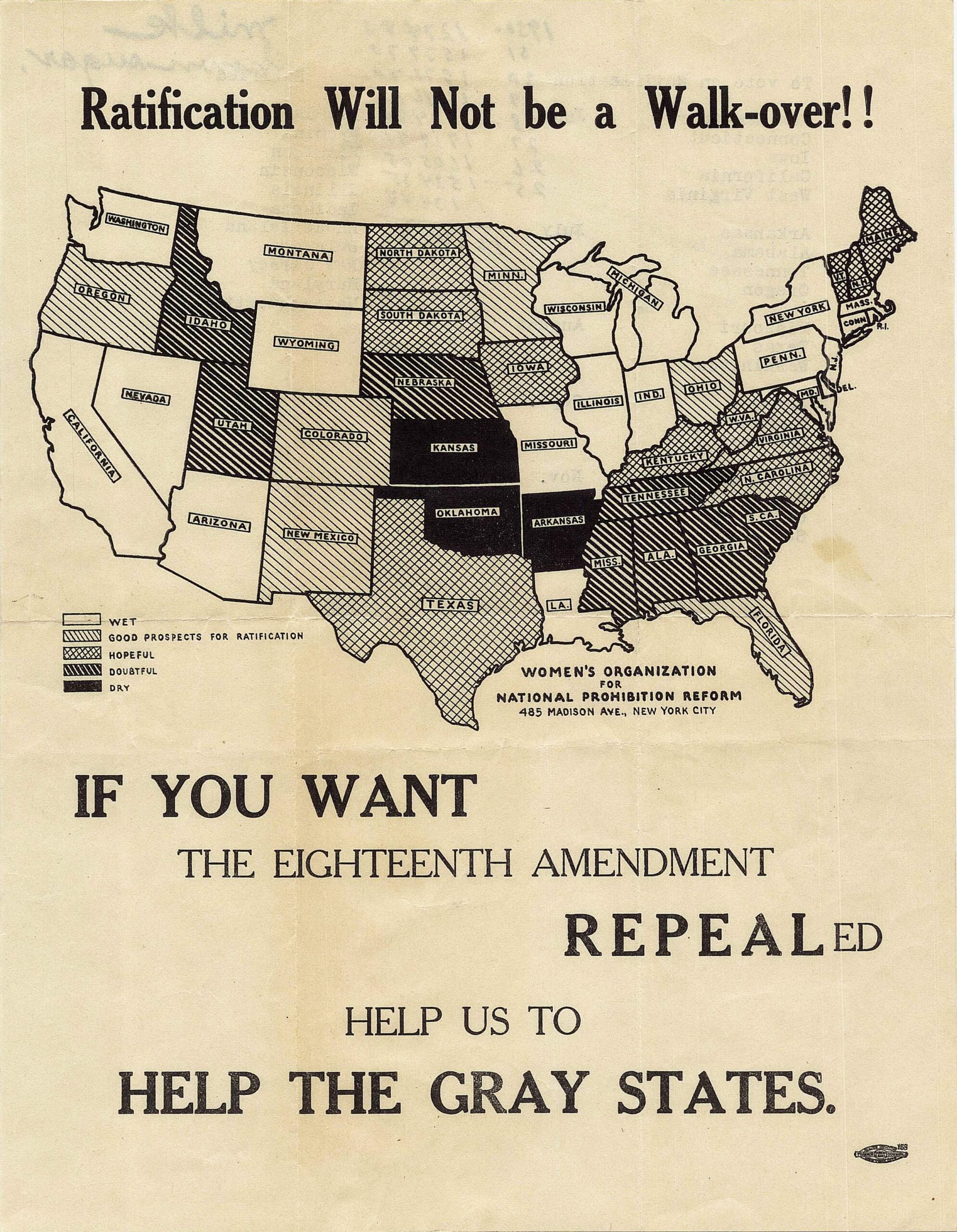
21st Amendment promoters soliciting the people representing their states in the vote to repeal the 18th Amendment in 1933.
by Mike Kapic – February 4, 2026
Summary
The convention records show us that the commisioners ended their meetings with the purpose of taking their proposed results back home to their legislatures and the next steps. The Constitution has not changed during the convention.
After the convention adopts an amendment, Article V instructs,
“…shall be valid […] as part of this Constitution, when ratified by legislatures of three fourths of the several states, or by conventions in three fourths there of, as the one or the other mode of ratification may be proposed by the Congress.”
State legislatures have approved twenty-six of the 27 proposed amendments to the Constitution. The 21st Amendment repealed the Eighteenth and was approved by the people representing their states in convention with an up or down vote based on the states “dry” versus “wet” status.
The Article V process is completed when the vote of the last state legislature or convention meets its Constitutional threshold. At that moment the a Constitutional act has been consummated. Congress may now announce (call) it (Dillon v. Gloss – 1921 ).
***
The Revolutionary War ran from April of 1775 to September of 1783. The writing of the first constitution, the Articles of Confederation, by the states began in June of 1776 by John Dickinson and after many revisions by Congress and others, was adopted by Congress and ratified by all the states in March of 1781.
Unfortunately, it had no judicial system, only one chamber and each state had one vote, all laws required ¾ of the state’s approval, amending the Articles of Confederation requiered 100% state vote, Congress couldn’t collect taxes to fund any operations, there were thirteen individual foreign policies, each had its own monetary system, Congress couldn’t settle the war debts, and Shay’s rebellion couldn’t be put down. The Founders realized that the new Confederation was critically ineffective.
The Philadelphia constitutional gathering adopted the commonly used meeting by convention of states to reform the government over the coming four months of the hot and humid summer of 1787. Four of the Confederation’s articles are still in the document, renamed the U.S. Constitution.
Federalist Papers
Because the Framers of the Constitution required that the people approve the proposed Constitution as their reformed government, they would need to understand the clauses intentions. Thus eight-five Federalist Papers were written as a broad explanation of the short 4400 word document they were about to vote yea or nay on.
A number of Anti-Federalist papers were penned and printed at the same time arguing that the new Constitution was too powerful and detrimental to individual liberties. There seems to be some truth in that claim today, but not then.
Beginning in the Fall of 1787 to June of 1788, states met in conventions to vote. Delware was the first state to approve. New Hampshire became the 3/4th state. The last state was Rhoad Island who ratified it in May of 1790; all threeteen states approved the new U.S. Constitution.
Will a New Federalist Papers Be Required Today?
The complexity encountered by the upcoming BBA/FRA proposals by delegates in drafting a fiscal responsibility amendment will be complicated and demanding. Financial reforms intended to limit and restrict the current government to controled spending and the restoration of fiscal responsibility will require fortitude and courage if they’re to last decades and into the coming centuries.
In addition, the plan for transitioning from the current budgeting system and its fund distributions will have to be planned out, entailing a multi-year conversion effort to the new system.
Consideration of new fiscal rules for debt and deficit, revenue and expenditures necessary for Congress to abide and write legislation, will need to be understood.
Ratification
Legislation submitted to Congress in February 2024, HCR15 by Rep. Arrington R-TX, asked Congress to call the convention and it also contained the ratification method as follows:
RATIFICATION OF AMENDMENTS BY STATES.
Each proposed amendment at the Convention for proposing amendments called under this section shall be ratified by a vote of We the People in three-quarters (38) of the States via State Convention delegates who shall ‘‘have no ground for reversing the vote of millions of its citizens’’ Chiafalo v. Washington (2020).
Congress and the States may want to consider the value of citizens having a hand in their own future.
Supreme Court and Ratification
The Court’s ruling, Dillon v. Gloss (1921), tells us two facts about Article V. One, there is no restriction on approval time limits unless the authors of the amendment set one. Second, the moment the last Article V threshold state vote is consummated, a constitutional act in Article V, be it ratification or on application, then becomes the law of the land. Anything beyond that date is immaterial and is simply an acknowledgement or announcement.
Dillon confirms the Founders desire (Federalist No. 43) that a constitutional act is consummated by meeting both the ¾ approval and the 2/3 calling.)
The People
There have been two times when We the People have actually had a hand in a U.S. Constitutions function besides an election. The Constitutions ratification through Article VII in 1788 and the 21st Amendment in 1933.
The states in convention is a part of America’s DNA. Anything denying that is Constitutional mysticism.
Next, and final, the States.



Leave A Comment